Friday, January 28, 2022

Consider the Animals


Consider the Animals

by Rev. Dr. Dee Cooper

 As I started receiving texts and notices, and seeing Facebook posts, I realized something was horribly wrong in the area where I live. Boulder County was on fire. The largest urban fires in the history of the state. Most of us reached out to those we loved, asking if they needed help evacuating, getting animals safe, etc. Roads closed for support teams to get in to help. Helpless, we watched as the 100 mph winds, the heat, and the tinderbox conditions prohibited much to be done but to watch, cry, and pray. It was a devastating shock, yet one that was inevitable because of the climate changes we have been experiencing. For months, we have experienced too warm days and no snow—an equation for a firestorm and evidence of climate change.


We started hearing the statistics of the devastation:  6000 acres, 1100 homes, and 2 human deaths. There was always a vague acknowledgment of the numerous deaths of wildlife, pets, and animals. And yet, as we heard the specific statistics concerning land, houses, and human casualties, there was nothing but a generalized mention of the numbers of pets and wildlife lost. I wondered aloud why don't we count the animals? Is it too hard? Do we think, oh well, they are only animals? Do their lives not matter? 


It's not a surprise because for decades, people of faith discussed climate change and environmental justice, but we often didn’t make the connection to the animals that share this planet with us. We don’t realize that God calls us to make a difference. Animals matter to us, and we are responsible for protecting species and providing them with conditions that bring forth their best living intentions.


As a person who for decades has been an animal advocate, a spokesperson for the endangered species act, and who built a business on what we can learn from animals, I often receive the same response. Well, isn't that cute? You have a tender heart for animals. My reaction is not as cute. Demonstrated throughout scripture,  we are called to protect the earth's species and challenged to consider our relationship with them as teachers and colleagues, not just objects that we exploit.


We are quick to focus on water, air, earth, trees, pollution, natural disasters, and the impact of climate change on humans. We often leave out another considerable component of our ecosystem and this earth. The animals. Those characters of the creation story were birthed on this earth before humans took their first breath. Those that:


~Creator God used the same matter to create us from that they were already created. 


~Loving God entrusted Adam and Eve to name, thus seeing, recognizing, and understanding they are a part of this beloved community. 


~Covenanting God commanded Noah to provide for the survival of the species.

~Inviting God shared with Job and us to consider the animals' healing wisdom and nature.


~Comical God used Balam's ass to vocalize human words of justice to confront harm and abuse and violence.


~Imaginative God chose to infuse the prophets with imagery from the animal world of what the beloved kin-dom would look like.


~That our beloved God, through Jesus, loved, illustrated, and engaged throughout his ministry on earth.


As much as we can easily see the through-line in scripture that brings forth an invitation for love, there is a through-line that says we are to care for this creation, which includes her creatures!


The animals are part of creation. We must grasp this reality. As a denomination, we are engaged in the Matthew 25 call that includes environmental justice. As an activist for environmental justice on many levels, I notice that there is a lightbulb moment when I speak to groups. Oh yes, we love animals, AND we are given a huge responsibility to support them in their existence, prevent exploitation and habitat destruction, recognize that pollution impacts them, and realize their survival is consequentially linked to our survival. So these days, as we have found such deep healing in being with our furry companions, learning from feathered friends in the air, and the finned creatures of the deep, consider this question. Might we expand our understanding of environmental justice to include their voices, to be their voices, in making a difference in this world? Might their lives matter and be counted in our awareness and in the practice of faithful stewardship?


Rev. Dr.
Dee Cooper is the Gap Presbyter of Coastlands Presbytery (New Jersey). She is also a Certified Coach through the Hendricks Institute. Dee serves on the Presbytery Mission Agency Board and is the moderator for the Presbyterian Mental Health Network.  Dee has her own business, Adventures for the Wild at Heart, where she connects people with animals in the wild or in rescue.

Finding the Good Wine is Also Good-for-the-Earth


Paul Slaikeu

Finding the Good Wine is also Good-for-the Earth

by Rev. Mary Beene

I thought 2021 was going to be all about coping with scarcity, instead it positively changed my engagement with, and my approach to, my vineyard, with unexpectedly positive results.” – Paul Slaikeu


Paul Slaikeu is the Vice-Moderator of the Presbytery of the Redwoods and an award-winning home winemaker in Californias Sonoma County. His home in Healdsburg, CA is surrounded by larger commercial vineyards and winery tasting rooms, but his annual 20-24 case output supplies not only his family and friends, but his home church with their communion wine.

Living in wine country, one of the small but noticeable sacrifices during COVID has been our shift from serving both wine and grape juice by intinction during the Lords Supper,” admits Rev. Mary Beene, pastor at Windsor Presbyterian Church. Pauls wine, often served with homemade bread, was a highlight of the service, truly demonstrating Gods goodness in the fruit of the vine. We could joke that Paul didnt save the good wine for last, waiting for Jesus to turn water into wine,” says Beene. Paul performed that miracle twice a month by sharing his bounty with us.”

But it is not really a miracle. It is hard work that turns nearly 500 gallons of water a week during growing season into beautiful grapes that can be fermented into great wines. In 2014, he even won a Gold Medal for his Zinfandel.

Paul planted his 116 vines on a steeply sloped yard next to his home. Always a connoisseur of fine wines, Paul had turned his husband Martin into a wine-lover on a wine club trip after their third date. Through the years, they had enjoyed exploring how to pair wines with food and unabashedly call themselves foodies” who love to experiment with great pairings.

When they moved to Healdsburg in 2005, Martin went back to school to become a wine professional. Since harvest and winemaking season keeps him busy at work, he mostly consults while Paul does the heavy lifting of caring for the vines, harvesting, and making the wine. Paul planted his first vines in 2008 and made his first wine in 2011.

This past year, however, was different than previous years. Healdsburg and much of the western United States faced a serious drought situation. Commercial vineyards often have older vines that can withstand severe drought; they actually use less water than many other agricultural uses. Even so, many lost vines and grapes as water supplies dried out.

Very little rain fell during the traditional rainy season, which was completely dry from November 2020 to April 2021. By seasons end, Lake Mendicino, which supplies much of Healdsburgs water had no more water than before the rainy season started. Through the long summer it only got worse, as the lake levels fell so much that towns flooded to form the lake decades before were suddenly visible again on the cracked, dry bottom.

Healdsburg placed a severe limit on all water uses inside and outside homes. The drought threatened not only agriculture, but homes, as the previous years fires had raged in the drought-stricken hills around Healdsburg. So the city of Healdsburg got serious about limiting water usage. They worked out a special program for residents to use recycled, non-potable wastewater in a bid to teach conservation in an area where drought is likely to become more common.

Another Healdsburg resident from the Windsor Church told Paul about the program that would provide up to 500 gallons of wastewater per week for residents. The city provided the transportation for free if residents could provide storage containers. Paul started calculating and found that his drip system for the vines used 116 gallons per hour for several hours per week, estimating about 500 gallons total. He jumped into motion, signing up for the program, securing first 250 gallons of storage and then a 500-gallon tank and a small electric pump to ensure the system worked.

His first goal was to just keep the vines alive through a draught-stricken summer, prioritizing the health of the vines over producing grapes. He cut back on watering to once per week, watering only the grapes and some fruit trees on the property and allowing the other ornamental landscaping to survive if it could without water.

As grapes started to appear, he pruned nearly half the clusters, allowing only one bunch at most per branch, rather than a typical two or more. He paid more attention close to harvest time to make sure the vines were surviving the dry, hot summer and fall. The dry year did bring some benefits, as he had fewer problems with disease and powdery mildew. And he found one more very unexpected benefit.

In pruning so carefully and paying more attention throughout the year to the vines, the grapes were superb. Because he was in the vineyard almost every day, they were picked at the most ideal time. When Paul and Martin tasted the wine after the grapesprimary fermentation, Martin told him that this year would be the best wine he had ever made.

Paul admitted, I thought 2021 was going to be all about coping with scarcity, instead it positively changed my engagement with, and my approach to my vineyard, with unexpectedly positive results.”

Although he made only 11 cases versus the usual 20-24 cases, he is very pleased with the years production. When theres a constraint, a limitation, it really makes me pay attention. I could have always been doing this; I could have had better vintages all along.”

Paul also noticed that this happened with electrical usage in past years as well. I never paid attention to my electricity until I got solar panels and started monitoring it.” This years drought and Healdsburgs water conservation programs made him more mindful of his water use, not only in the vineyard, but in the house, as well. I bought a Flume water monitor and we now take shorter showers and flush the toilet less, because we found out that we can.”

He lost only a few ornamental plants in his other landscaping, despite not watering there at all. It turns out that when he told his landscaper to put in draught tolerant plants, he could trust that they were truly well xeriscaped. He says he may never water that part of the yard again. These kinds of permanent changes can make a real difference in the community as we learn to live in greater harmony with Gods creation.


Rev. Mary Beene is pastor of Windsor Presbyterian Church in Windsor, CA. Mary grew up near Detroit, attended high school in Pennsylvania, majored in environmental science and German at Allegheny College, served in the Peace Corps in Hungary, earned a Masters in Public Administration at American University in Washington DC and worked for over 12 years for environmental non-profits in DC and Boston with an emphasis on board training and fundraising. 

A Little Garden Fosters Big Community


 A Little Garden Fosters Big Community

by Charron Andrews with Nancy Corson Carter 

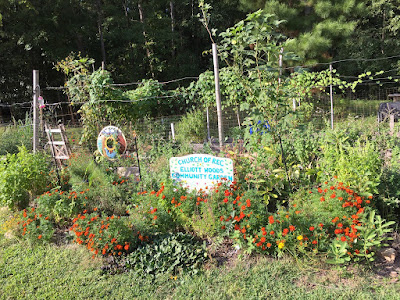
As is often the case, projects begin with one particular dreamer. Thered been a few who tossed around ideas for a community garden for the Church of Reconciliation (PCUSA) in Chapel Hill, NC, but in 2018 Charron Andrews dreamed one into reality. The fact that shed had little previous gardening experience didnt matter. She received a grant from the Orange County Extension Service to community gardens, and CREW, or Church of Reconciliation Elliott Woods Community Garden, was born. That led to gathering people at the church (fondly known as the Rec”) and neighboring Elliott Woods Apartments (linked to the church by land-sharing) to figure out where the garden would be located, how it would get built, and what its purpose and goals would be.


Simple goals were established: to provide an opportunity to grow food, to show people how amazing that process could be, and to provide fresh produce for folks in the community. A basic rule was to show kindness to the living world around it (probably a fence, but no toxic weed control) and hospitality to whoever came to visit.


The only reliable and available water source was at the church near the courtyard quadrangle, so the plots began there. The gardens first real shaping came when ten to twelve people came out for a work day to build four raised boxes. These were made from boards milled by Craig DeBussey, a skilled Rec carpenter, from trees taken down to build the churchs fellowship hall. Soil and compost were added. In fall and winter of 2019 and 2020 more helpers constructed a fence from bamboo poles and donated fencing. Bit by bit plants, compost, a wheelbarrow, and other garden supplies came from sources like church membershome gardens and the Briggs Avenue Community garden in Durham. A church neighbor, Vanessa Wood, supplied drip irrigation. A thrown-away composter in decent shape was pressed into service.


Then in March of 2020 the Coronavirus hit and most everything closed down. Charron remembers that the garden began to really come together during that summer when she, Marty Probst, and Chris Lunsford from Elliott Woods worked when most people were staying home, and the church property was very quiet. Within the fenced area they tried out lots of different vegetables and grew herbs and flowers needing protection from deer. They made a storage cabinet for the nearby porch on the side of our parish house. Best of all for community purposes, they set out garden furniture donated by friends. With indoor restrictions due to COVID, the porch was well-used in 2020-21. If you walked by on any given day, you might see a woman reading with some students from Elliott Woods, a small committee meeting in progress, or our pastor meeting with a member of the congregation.


In winter of 2020-21 seeds were started in mini greenhouses of plastic milk jugs. (Such improvisational creativity flourishes in this garden!) In spring 2021 these and other plants were placed in the soil, and we expanded the fenced-in area to grow melons and cantaloupes at the request of some Elliott Woods residents. That led to applying for and receiving two more small grants (about $300 each) from the Orange County Extension Office to replace fences needing repair.


While the garden has grown to fill much of the once all-grass quadrangle, there was still enough green space for the Brassissimo! group to play for Easter Sunrise service, and for various other events in that area. The Earth Care Committee met there for a Summer Solstice gathering to tell Native American and Celtic stories, and to dance the grieving-gladdening Elm Dance that Joanna Macy brought back from the nuclear disaster at Chernobyl. A Carolina Garden Coaching leader, Tionniaya Liske, came to talk about gardening with young people; her visit gave valuable information and prompted attendees to tell their own garden stories. One small group came in the summer to listen to live music.


At the same time workers grew food. There were huge okra plants and a bounty of green peppers that Chris Lunsford planted. Other vegetables included Malabar spinach, tomatoes, eggplant, ground cherries, squash, and more flowers and herbs. Basil was a favorite that congregation members were encouraged to gather for themselves. There was even a little free produce stand placed next to the Little Free Library on Elliott Woods Road (on the other side of the parish house) where vegetables were offered to passersby.


Charron says that the garden certainly has been a source of Gods love and care for me,” and others seem to have that same sense. Working there during late warm afternoons, she might meet school children taking a short cut to the apartments behind the church property. One middle-school boy liked to stop to observe the bees and the flowers growing, more than once announcing, I love this garden!” Noting a woman who frequently came to sit on the porch and read with one of the children from the apartments, Charron asked if theyd like to plant something. They chose a baby watermelon that grew plump with sweetness, and a moonflower vine that later decorated the fence with its exotic evening blooms.


When another woman learned of the small community garden at the church and what it meant for Charron during the pandemic, she came over to see it and fell in love. It reminded her of her own growing-up story that included living on a small farm. She wanted to get her hands in the soil but had trouble reaching down to the raised beds. Charron constructed a small waist-high box from supplies at hand and labeled it Joyces Garden.” She was delighted to be able to plant her own lettuce and greens. Now, in wintertime, Joyce reports that she often dreams about the garden.


In this winter of 2021-22 a variety of plants are readying for spring. The coming of a new pastor, Rev. Allen Brimer, who is also a farmer, is an encouraging sign for new and continuing uses of the garden and its surroundings at the Church of Reconciliation. We may repeat our 2017 celebration of the Jewish Birthday [or New Year] of the Trees,” Tu BShevat, by planting another fig tree. Possibilities of working with a property-wide planting plan are in the wind.


One of the highlights in the gardens life has been in celebrating rituals of blessing. Most recently we used Interfaith Power & Lights Garden Blessing materials from their week-long program Sacred Ground: Cultivating Connections: Food, Faith, and Climate,” April 16-25, 2021l. Words (lightly edited) from the opening of this IPL blessing give a sense of what it means when A Little Garden and Its Communities Help Grow Each Other:


Holy God: Gathered to bless our gardens, we ask that their fruits nourish their communities and restore justice to all…. Bless the workers of our gardens, that they may  enjoy community amongst themselves and the plants—and with all their neighbors—and find spiritual sustenance in those connections…. We give our most heartfelt thanks for the blessings we receive from our gardens.”


Charron Andrews is an artist and physical therapist. 
Nancy Corson Carter is a writer and professor emerita of humanities at Eckerd College. Her most recent book is A GREEN BOUGH: POEMS FOR RENEWAL (2019).

An Eco-Theologian’s Journey

Rev. Dr. Neddy Astudillo


An Eco-Theologian’s Journey

 by Eric Diekhans

 Growing up in Venezuela and Argentina, Rev. Dr. Neddy Astudillo’s remembers experiencing the beauty of creation when she visited the ocean with her family. So it seemed only natural that dreams of the ocean would lead her on a life-long journey as an eco-theologian.


The dreams occurred when Astudillo was studying sociology at Universidad Central de Venezuela, struggling to figure out what to do with her life. Her parents were committed to the ministry in the Presbyterian church, and she longed to hear God calling for her, and to make a difference in the world.


“I would see myself under the water,” says Astudillo, “swimming with dolphins, unconcerned about having enough oxygen to breathe. I felt love. I felt something that I cannot compare in my awake life.”


 A short time later, Astudillo read an article about the killing of dolphins by the Venezuelan fishing industry. She attended a public forum on the issue, and asked the organizers how she could help. For more than a year, they had been searching for a sociologist to work with on a project. By the following day, Astudillo was volunteering with them.


“I was able to get my university to accept the work as one of my research projects,” says Astudillo, “and that's how my life was just turned around.”


Astudillo brought her new interest in environmental justice back to her church, where she was a youth leader. But she didn’t feel she had the theological background to fully share why God was calling people of faith to take care of creation.


After college, she moved to Chicago to pursue a temporary opportunity and learned about McCormick Theological Seminary. “Somebody gave me one of those booklets with all the courses and I realized they were teaching the theology of creation. I understood that the church here had already recognized this as a new ministry.”


While at McCormick, Astudillo met her future husband, Tom Spaulding. When she became seriously ill, she started reading about the healing properties of heathy foods. After earning an M.Div., she and Spaulding joined Angelic Organics, a community supported farm in Illinois, and helped start the Angelic Organics Learning Center, offering education and training for children and adults.


During her twenty years at Angelic Organics, Astudillo also became pastor of Parroquia San Jose, an ecumenical Lutheran and Presbyterian Latino ministry in Beloit, Wisconsin. While serving there, Astudillo started hearing more loudly about the climate crisis.


“My desire was always to go back to Venezuela,, where I had been very involved with the Latin American Council of Churches. I wanted to share the creation care tools I’d been learning in the United States. I was able, as part of my doctoral project, to teach in seminaries in Latin America. I really wanted to create a program that was sensitive and contextual to the Latin American experience. Three seminaries gave me an opportunity to test the course in Bolivia and Peru, and Guatemala.”


Astudillo’s next calling on her journey as an eco-theologian was to return to the United States as Director for Training and LatinioAmerica at Greenfaith, an interfaith environmental advocacy organization.


“Institutional changes are important. Personal changes are very important, but systemic changes are what the world needs most today to confront the climate crisis.”


Greenfaith opened up an opportunity to come to Florida, where her journey has, in many ways, come full circle.


“It not a coincidence that here I am in Tampa, Florida,” says Astudillo, “seeking the ocean as my place of finding peace and being centered in love and beauty.”


Eric Diekhans
is a writer, Editor of Earth News, Senior Producer at the Greater Chicago Broadcast Ministries and an Elder at Lake View Presbyterian Church in Chicago.

Tuesday, November 16, 2021

COP 26 - Nov. 8-11 (Burkhard Paetzold)

Swarm Intelligence for another Future


by Burkhard Paetzold

PEC Representative at COP 26


Beehives

Walking along the hallways of the COP26 conference center in Glasgow feels like being part of a beehive. COP26 with a reported number of 40.000 participants is the largest global conference ever.


Being a beekeeper myself I know that our common image of a beehive being a chaotic “toing-and-froing” is not true. Bees constitute a larger organism with different groups of bees having specific roles. And, the patterns of their „dances“ are a “language” for communicating with each other. I won‘t go into detail, but it‘s fascinating to learn about this. In the end, however, we see this perceived chaos is actually a collective effort. Let’s call it swarm intelligence as a precondition to produce something beautiful, for creating the swarm’s future - honeycombs.


 Such an organism should be a beautiful image of the whole COP26 process. 


The truth is that unlike a beehive where only the queen bee, because of her ability to reproduce, has the power to hold this all together, in international relations some nations have more strength to push their interests through than others. Economically stronger nations have powerful fossil fuel lobby groups to put further pressure on the process. And, they do this not by competing in an open democratic process but by manipulation and through the back door.


The UN process, however, requires consensus, and that is good, but that process can’t avoid the tendency to water down language to the lowest common denominator.


 Beehives have a Subset of Hive frames

My „hive frames“ are the ecumenical and the wider faith community here at COP26. “Earth Beat” (https://us8.campaign-archive.com)  describes  “that both officials and the media have discovered the power of religious groups” and quotes the AP, “The faith-based movement for climate action knows no denominational boundaries, as leaders of most faith traditions see it as part of their mandate to care for the communities most vulnerable to climate change and preserve what they see as a divinely given environment”.

Without the ecumenical group organized by the ACT alliance, without our ACT colleagues’  tireless work, mindful guidance, and strong encouragement I would have been clearly lost.

And Fred and I even had some fun participating in stunts that ACT alliance set up focusing on three key messages: 


Financing Loss and Damage 

On Monday, November 8, we were actively involved in a stunt to promote a clear commitment to finance “loss and damage”. https://actalliance.org/act-news/climate-induced-loss-and-damage-is-a-harsh-reality-in-nepal-press-release-cop26/

Our action called for a solution to accept accountability for  “long-term impacts  like  sea-level  rises  as  well  as severe extreme weather events like Cyclone  Idai,  which  killed  more  than 1,000 people, left 400,000 homeless and destroyed 700,000 hectares of crops  when  it  struck  Mozambique  in 2019. International fundraising appeals raised less  than  50%  of  their  target, forcing  Mozambique  to  borrow  from international  institutions.”  As pointed out by MakeCopCount, (https://makecopcount.org/wp-content/uploads/2021/05/Faiths-briefing-combined-FINAL.pdf)

“Loss  and  damage  also  includes  ‘non-economic  losses’:  that  means  things you can’t  put  a  price on, like biodiversity, sacred lands, cultural monuments or local traditions.” (ebd.)


COP21 in Paris did not address loss and damage as an independent and additional category of financing with their own rules.


Fred’s and my role was symbolizing the rich nations ignoring loss and damage needs having their ears plugged with coal and are drunk from making money with oil.


Climate Justice is Gender Justice

On Tuesday, November 9,  I joined the call to „Climate justice is Gender Justice“ and we read  short stories of women in different countries in the Global South who lost their livelihood, their jobs, their houses, their plantations or their harvest because of climate disasters.

https://actalliance.org/act-news/there-is-no-climate-justice-without-gender-justice-media-release-cop26/

In many climate disasters, women and girls are among the most vulnerable. We want to keep the support for them as a priority and at the same time involve more women in climate mitigation and adaptation programs and projects which do not risk reinforcing patriarchal norms in climate solutions.  


Creation is not for Sale 

And our last stunt was on Thursday, November 11, „Creation is not for sale“ when Fred and I played two “distinguished gentlemen” trying  to bribe people  to give up on praying for diversity of nature, for human rights and for keeping the trajectory of 1.5 degrees alive.

All these stunts have been shared widely through ACT alliances’ excellent media people. The “loss and damage” stunt even hit the news in Dutch national TV.


Other Frames 

One of the other „hive frames“ in a COP conference is the national and transnational pavilions, science labs and UN entities that promote aspects of climate mitigation and adaptation, e.g. those which deal with wind or solar power or those which address health, economic cooperation, or renewable energy. 


Many pavilions set up their own programs, sometimes with a limited number of panelists or audiences, but zooming in panelists from Geneva or Cape Town, Santiago or Warsaw. 

Most programs are life streamed and can be accessed online from around the world.


And, all this hive activity happens in  parallel to the  plenaries, side events, group meetings, action zone meetings or those of best practice presentations. Several side events were organized across the city of Glasgow, some in churches, some in the Green Zone as well. 


The Zoomed-in panelists and the wider public or civil society able to participate wherever they are located, constitute an additional “global” frame for communication. 


I believe the different hive “frames” have a bond which unites them:


  • - a growing awareness of global injustice as result of a history of colonial conquest and slavery still visible today in unbalanced terms of trade and of inequities of perpetrator and victim of climate disasters
  • - the global networking of interdisciplinary  science - resulting in the IPCC report that paints an unambitious picture of the human-made climate crisis
  • - the youth taking to the streets for our common future
  • - the mushrooming of divesting from fossil fuel companies and investing in alternatives 
  • - the change of business models and products  (race to net-zero) 
  • - the collaboration of cities and towns with civil society and business stakeholders for sustainable neighborhoods to establish clean energy, human-centered transportation, smart heating and cooling 
  • - the implementation of proposals from environmentalists and naturalists
  • - a new spirituality and interfaith exchange about the common ground of our human existence
  • - the redefinition of health that refers to our environment and diet, 
  • - a growing awareness of the  interconnectedness of  food production, consumption and the climate crisis


I believe there is a momentum of collective wisdom. Isn’t the interwoven build up of all relationships to save human conditions by liberating God's creation on this globe a way to worship God?… like the way bee swarms produce honeycombs and care for and create their future is, in its deepest sense, a worship to the creator? 


What then, brothers? When you come together, each one has a hymn, a lesson, a revelation, a tongue, or an interpretation. Let all things be done for building up. (1 Corinthians 14:26)


Post Scriptum, November 13

1

I returned home on Friday, November 12 and am just finishing my diary while watching the COP26 “end-game,” and as always there are  “cliffhangers” and a “show down”. It looks like those who wanted to water down the Glasgow Climate Pact  and had been unable to succeed in the open argumentation process used a last minute intervention knowing they actually don’t have arguments, but power - I can only see this as their clear weakness.  Or as the trade union speaker at an NGO forum said: “We are many and you are few”. 

2

Please read the final press release of Act alliance at https://actalliance.org/act-news/faith-leaders-more-must-be-done-to-achieve-climate-justice-after-cop26/

Photo Simon Chambers

Photo Albin Hillert